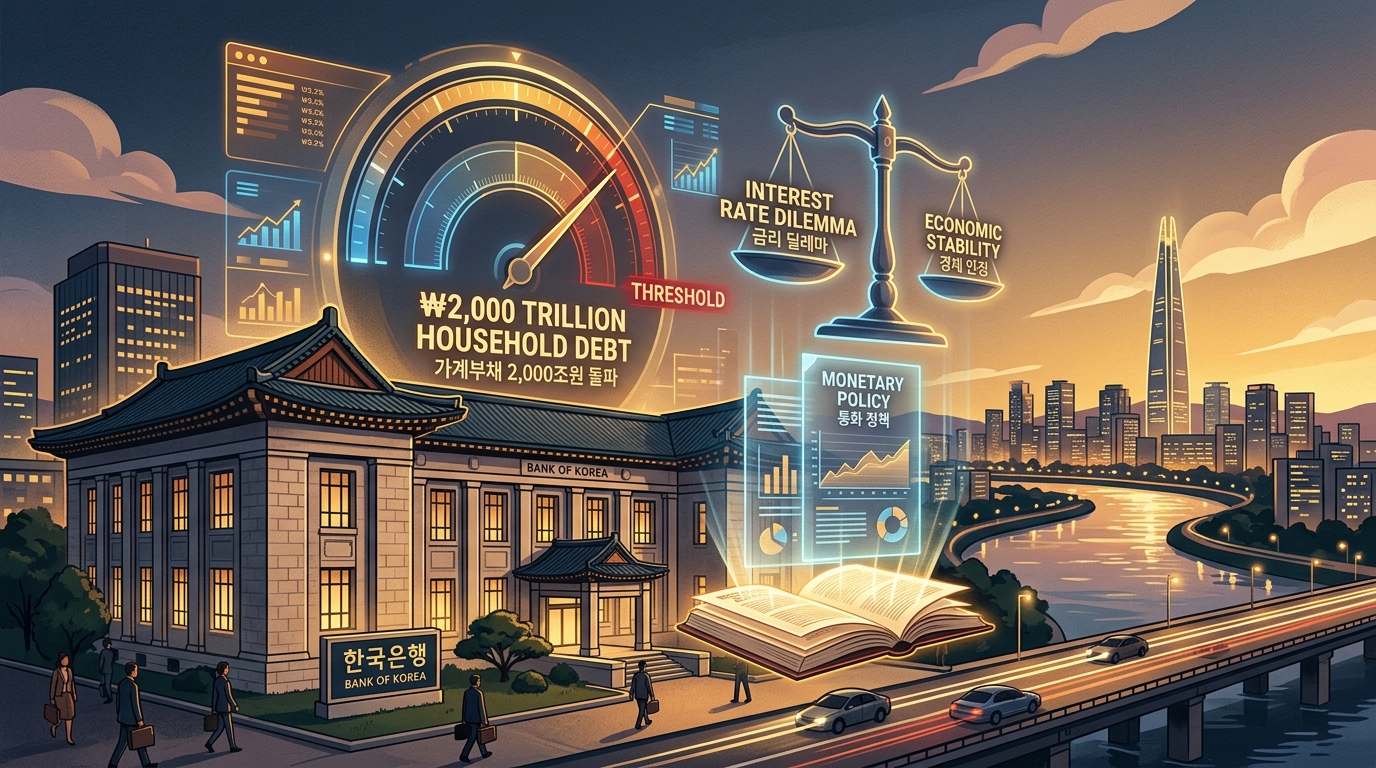
For the first time in South Korean economic history, total household credit has officially breached the 2,000 Trillion KRW mark (standing at 2,019.8 Trillion KRW / ~$1.5 Trillion USD). According to preliminary data released by the Bank of Korea (BOK), household debt surged by 25.9 Trillion KRW in the second quarter alone—the steepest three-month expansion since the 2021 pandemic real estate boom.
Ahead of the Monetary Policy Board meeting, Korea’s central bank faces a textbook dilemma: easing borrowing costs to support sluggish domestic consumption versus maintaining tight monetary policy to curb panic-buying across Seoul housing markets. Concurrently, commercial banks have unilaterally raised mortgage profit spreads, driving borrowing rates above 6.0% p.a. while clamping down on leasehold (Jeonse) financing.
This macroeconomic briefing breaks down the three underlying triggers of Korea’s 2,000 Trillion debt threshold, rate scenario simulations, and a 3-step survival playbook for residential mortgage borrowers.
📌 Executive 3-Point Summary:
- Record 2,019.8T KRW Debt: Driven by FOMO homebuying across greater Seoul, mortgage debt accounted for over 85% of Q2 credit expansion.
- Central Bank Dilemma: While retail bankruptcy rates call for rate cuts, real estate overheating and household leverage make an imminent Hawkish Hold the consensus outcome.
- Borrower Strategy: Sidestep commercial bank spread hikes by exploring non-bank insurer mortgages (DSR 50% allowance) and policy-backed fixed loans.
1. Deconstructing Korea’s 2,000T KRW Household Debt Milestone
2. Bank of Korea Dilemma: Domestic Slump vs. Financial Stability
BOK Governor Rhee Chang-yong and the Monetary Policy Board face opposing economic forces:
- The Case for Easing (Dovish):
- Domestic retail consumption remains severely suppressed.
- The US Federal Reserve’s dovish trajectory at Jackson Hole narrows cross-border interest rate differentials.
- The Case for Tightening/Hold (Hawkish):
- Early rate cuts risk signaling policy accommodation to Seoul real estate markets, fueling another housing bubble.
- Premature easing with household credit above 2,000T KRW could compromise systemic financial stability.
📌 [Market Consensus]
Over 79% of bond market analysts project the BOK will maintain its policy rate in a Hawkish Hold, emphasizing that monetary accommodation will be delayed until household debt growth slows convincingly.
3. Policy Rate Scenarios: Impact on Household Interest Burden
Comparison of financial outcomes across two central bank policy trajectories:
4. Commercial Bank Credit Restrictions
Regardless of central bank policy rates, commercial lenders have enacted defensive measures to meet regulatory growth caps:
- Aggressive Spread Hikes: Major commercial banks increased internal add-on margins multiple times, keeping mortgage rates above 6.0% p.a.
- Banning Conditional Jeonse Loans: Prohibiting tenant deposit loans executed on the date of property ownership transfer to block leveraged buy-to-let deals.
- Stage 3 Stress DSR Enforcement: Introducing heavier stress interest rates that reduce maximum borrowing caps by up to 65 Million KRW for prime borrowers.
5. 3-Step Borrower Survival Playbook
Explore Tier-2 Insurer Mortgage Inversion
Major domestic life insurers offer mortgage rates in the low 4% range with a higher 50% DSR ceiling, beating tier-1 commercial bank terms.
Capture Regional & Digital Bank Refinancing Quotas
Regional lenders (Busan Bank, iM Bank) and online banks release daily non-face-to-face refinancing quotas offering 0.30%p spread discounts.
Prioritize Statutory Policy Loans
Target subsidized programs (Didimdol, Newborn Special Loan) exempt from Stress DSR that lock in fixed 1%–2% interest rates.
6. Frequently Asked Questions (FAQ)
Q1. Does 2,000 Trillion KRW debt indicate an imminent financial crisis?
No. Overall household loan delinquency remains between 0.3% and 0.4%, significantly lower than during the 2008 global financial crisis. However, because over 70% of loans carry variable rates, prolonged high borrowing costs will continue to dampen domestic private consumption.
Q2. Why are borrowing rates rising if benchmark bond yields declined?
Commercial banks face mandatory regulatory loan caps. To slow down credit demand, banks artificially increased their internal profit margin spreads, negating lower market bond yields.
Q3. What happens if a conditional Jeonse loan is rejected at settlement?
Borrowers should immediately consult non-bank lenders (credit unions, mutual finance) where such restrictions may not apply, or negotiate a split closing timeline with the seller to prevent earnest deposit forfeiture.
🔗 Related Macroeconomic & Mortgage Guides: