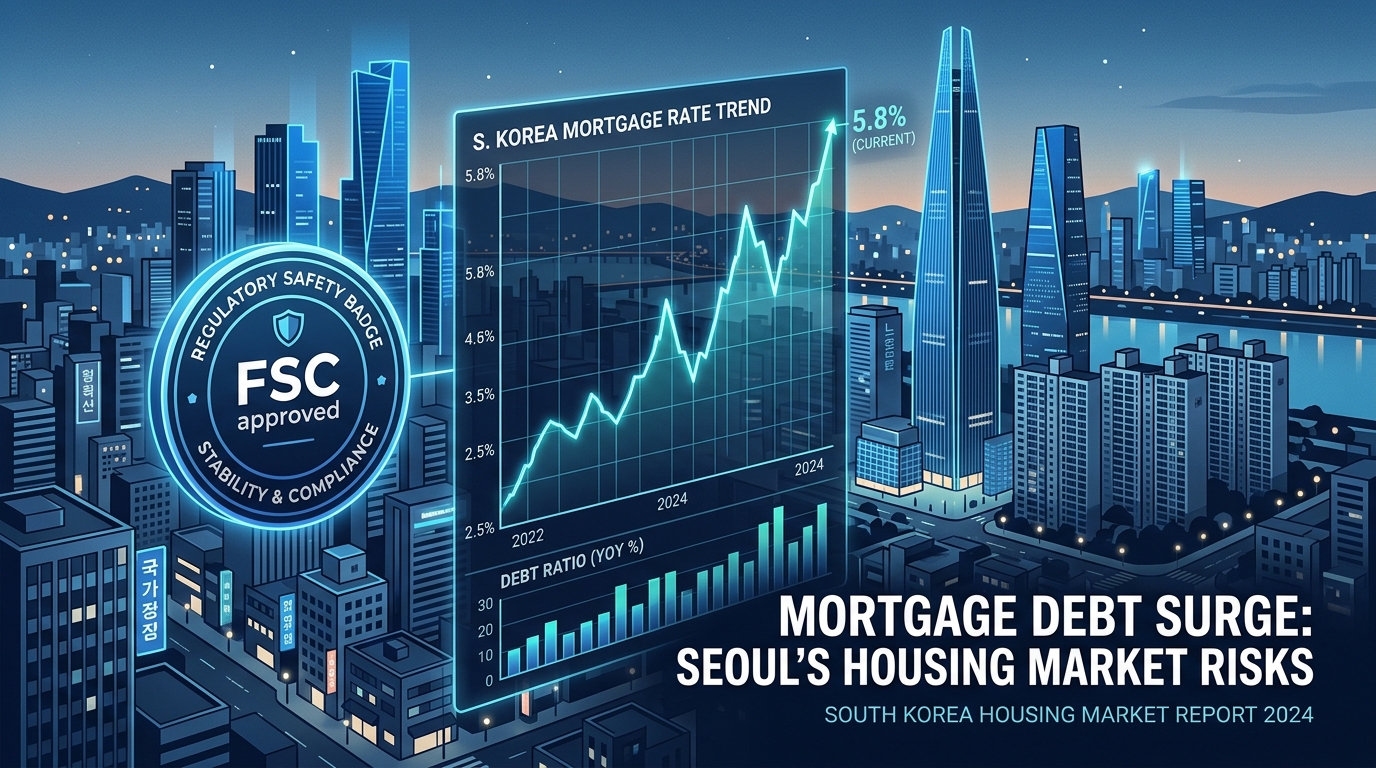
The single most consequential financial regulatory shift in South Korea is the full implementation of Stage 3 Stress DSR (Debt Service Ratio) in the Seoul Metropolitan Area.
To rein in surging household debt and cool overheated real estate in Seoul and Gyeonggi province, Korean financial regulators have enacted a strict dual-track regime. Consequently, homebuyers and expat residents seeking mortgages in the capital region face an unprecedented reduction in borrowing power—slashing loan limits by up to 28% (nearly 100M to 250M KRW).
This verified report breaks down official Financial Services Commission (FSC) data, provides exact before-and-after loan limit simulations across annual salary brackets (50M, 80M, and 100M KRW), and outlines concrete financing workarounds.
📢 [August 2026 Macro & Interest Rate Update]
Following the 2026 Jackson Hole Symposium and impending Bank of Korea rate decisions with household debt crossing 2,000 Trillion KRW, read our latest 2026 Jackson Hole & Bank of Korea Rate Dilemma Macro Report.
The 30-Second Executive Summary
- 📌The Bottom Line: Your salary and credit score remain unchanged, yet commercial banks will lend you 60M to 90M KRW less for any property in Seoul.
- ⚖️How It Works: Regulators test your debt capacity not at today’s 4.0% rate, but under a simulated “worst-case 7.0% rate spike scenario”.
- 🚨Immediate Action: Cancel inactive Overdraft Credit Lines (마이너스통장). Even with a zero balance, banks treat the full credit limit as active principal debt.
💡 Pro Workaround: Extending mortgage tenure from 30 to 40 years and selecting a 5-year fixed hybrid rate recovers up to 70% of lost borrowing capacity legally.
1. What is Stage 3 Stress DSR? (Seoul vs. Regional Dual-Track Policy)
Stress DSR is a macroprudential framework that calculates your borrowing limit not on your nominal interest rate, but by adding a hypothetical stress rate buffer to test whether you can withstand future interest rate hikes.
Crucial Rule: The stress interest rate (+3.0%) is purely an underwriting test metric, not the actual interest rate you pay monthly. Your monthly repayments are still billed at your contract rate (e.g., 4.0%), but your maximum approved principal drops significantly.
2. [Verified Simulation] Mortgage Limit Drops by Salary Bracket
Assuming a standard 30-year maturity, equal principal & interest repayment, commercial bank 40% DSR ceiling, and no other existing debts, here is the exact loan reduction in Seoul:
| Annual Salary Bracket (KRW) | Pre-Regulation Limit (4.0% Underwriting) | Stage 3 Stress DSR Limit (7.0% Underwriting) | Actual Loan Reduction (Lost Ceiling) |
|---|---|---|---|
| 50,000,000 KRW | ~349,000,000 KRW | ~250,000,000 KRW | 🔻 -99,000,000 KRW (-28.4%) |
| 80,000,000 KRW | ~558,000,000 KRW | ~400,000,000 KRW | 🔻 -158,000,000 KRW (-28.3%) |
| 100,000,000 KRW | ~698,000,000 KRW | ~501,000,000 KRW | 🔻 -197,000,000 KRW (-28.2%) |
| Dual Income 130,000,000 KRW | ~907,000,000 KRW | ~651,000,000 KRW | 🔻 -256,000,000 KRW (-28.2%) |
Source: Financial Supervisory Service (FSS) Fine Simulation Model (Commercial Bank 40% DSR, 30-Year Term).
For an individual earning 50M KRW annually, a previously reachable 350M KRW apartment mortgage is now capped at 250M KRW—requiring 100M KRW more in liquid cash equity to close the purchase.
3. 3 Strategic Workarounds to Reclaim Borrowing Capacity
To avoid falling short of capital before closing real estate contracts, adopt these three proven financing workarounds:
Cancel Unused Credit Lines (Minus Bankbooks)
In Korea, the entire approved limit of an overdraft account (Minus Tongjang) counts against your DSR, even with a zero balance. Canceling a 50M KRW overdraft can restore tens of millions in mortgage capacity.
Extend Mortgage Maturity to 40 or 50 Years
Extending your loan term from 30 to 40 years spreads out the annual principal amortization, lowering your annual debt burden and recovering 40M to 60M KRW in borrowing limit.
Leverage Government Policy Loans (Didimdol / Bogeumjari)
Government-backed mortgages (such as Newborn Special Loans or Didimdol) are exempted from commercial Stress DSR rules or benefit from relaxed underwriting standards.
4. Key Takeaways for Expat & Global Homebuyers in Korea
- Pre-Qualify Before Bidding: Never rely on outdated online loan calculators. Always assume a 25% reduction from baseline figures when budgeting Seoul real estate.
- Consolidate Secondary Debt First: High-interest credit loans and card loans severely restrict your DSR ceiling. Pay off high-rate secondary debt before submitting primary mortgage applications.
- Check Expat Policy Mortgage Eligibility: If you are a permanent resident (F-5) or married to a Korean national (F-6), check your eligibility for subsidized government mortgage programs that bypass commercial Stress DSR restrictions.