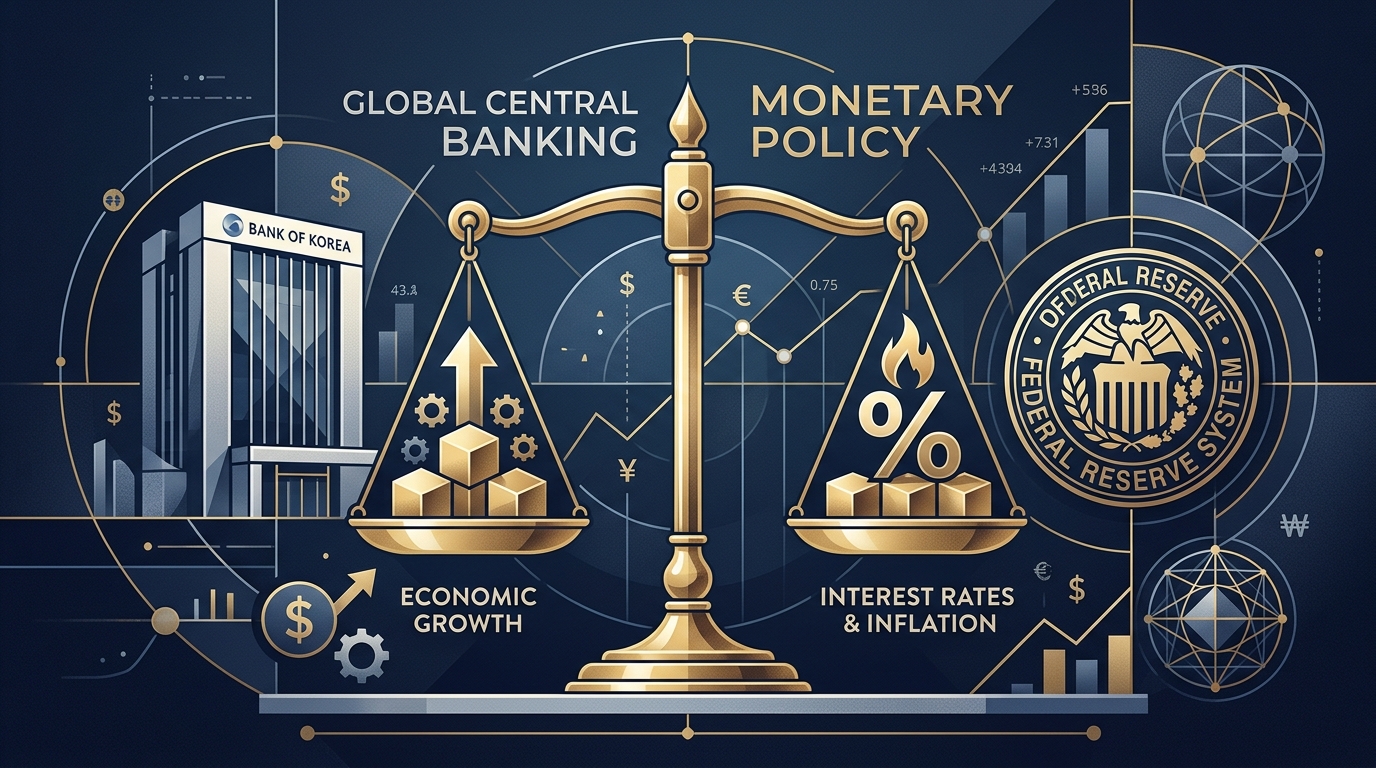
The annual Jackson Hole Economic Policy Symposium (August 21–23, 2026) hosted by the Federal Reserve Bank of Kansas City, coupled with the Bank of Korea’s (BOK) August 27 Monetary Policy Committee rate decision, represents the most critical macro turning point for global capital flows and Korean domestic households.
With US Federal Reserve policy guidance emphasizing strict data dependency amidst Middle Eastern inflation frictions, South Korea faces an acute policy dilemma: national household credit has breached an unprecedented 2,000 Trillion KRW ($1.5 Trillion), colliding with heated Seoul metropolitan real estate valuations and pushing commercial mortgage rates past the 6.0% barrier.
This master guide details the key monetary signals from Jackson Hole, comparative BOK rate scenarios, mortgage borrower optimization (fixed vs. variable spreads), and FX risk mitigation for international investors.
The 30-Second Executive Summary
- 📌The Core Dilemma: To stimulate consumption, the Bank of Korea should cut rates, but cutting rates risks exploding Seoul property bubbles and 2,000T KRW debt, paralyzing policy agility.
- 🏠Mortgage Strategy: Commercial banks have raised loan spreads, pushing variable rates to 6.0%. Switching to a 3-5 year fixed hybrid product saves 0.5% to 0.8%p in interest immediately.
- 🇺🇸Expat & FX Portfolio: With USD/KRW trading elevated above 1,350 KRW, hedge currency risk by allocating into dividend-growth cash flow (SCHD) and currency-hedged (H) index ETFs.
💡 Pro Workaround: High-yield parking accounts are dropping toward 3.0% APY. Reallocate 6-month idle cash into Retail Sovereign Bonds or short-duration bond ETFs to lock in yields.
1. 3 Macro Focal Points: Jackson Hole & BOK August Meeting
2. Bank of Korea August 27 Rate Scenarios
| Macro Dimension | Scenario A: 0.25%p Rate Hike (3.00%) | Scenario B: Strategic Rate Hold (2.75%) |
|---|---|---|
| Primary Policy Rationale | Curb 2,000T KRW debt expansion & cool Seoul property speculation | Protect domestic retail recovery & shield vulnerable debt holders |
| USD/KRW Exchange Rate | Narrows US-Korea interest rate spread ➔ KRW strengthens to 1,320–1,340 | Lingering high US rates ➔ KRW hovers at elevated 1,360–1,390 levels |
| Mortgage Borrowing Rates | COFIX benchmark increases ➔ Mortgage rates escalate to 5.8%–6.5% | Commercial bank spreads plateau at 4.8%–5.8% range |
| Equities & Asset Markets | Short-term liquidity tightening exerts pressure on KOSPI | High-dividend defensive blue chips outperform tech growth |
3. [Verified Simulation] 0.25%p Rate Hike Impact on 300M KRW Mortgages
Calculated over a 30-year amortizing principal and interest mortgage schedule:
| Borrowed Principal | Benchmark Rate (4.80% p.a.) | Post-Hike Rate (+0.25%p ➔ 5.05%) | Monthly Payment Increase | 30-Year Lifetime Interest Added |
|---|---|---|---|---|
| 300 Million KRW | ~1,574,000 KRW / mo | ~1,620,000 KRW / mo | 💰 +46,000 KRW / mo | +16,560,000 KRW |
| 500 Million KRW | ~2,624,000 KRW / mo | ~2,701,000 KRW / mo | 💰 +77,000 KRW / mo | +27,720,000 KRW |
| Fixed vs. Variable Spread | Fixed 5-Year (4.10%) | Variable (5.20%) | +330,000 KRW Spread | 🏆 Fixed saves > 118 Million KRW! |
4. 3-Step Action Blueprint for Borrowers & Global Investors
Lock in 5-Year Periodic Fixed Rates for New Mortgages
Commercial bank periodic fixed rates sit 0.5%–1.0%p below variable products. Lock in fixed tranches to cap interest liabilities.
Deploy Dollar-Cost Averaging (DCA) on US Tech Equities
When USD/KRW exceeds 1,350, avoid lump-sum purchases. Accumulate index ETFs (SPLG, QQQM, SCHD) in phased monthly increments.
Park Liquid Cash in High-Yield Digital Accounts (2.5%)
Preserve flexibility in Kbank Plus Box or Toss Bank Daily Interest accounts earning daily compound yield while awaiting rate clarity.
5. Frequently Asked Questions (FAQ)
Q1. How should investors position US portfolios post-Jackson Hole?
Given potential volatility in tech multiples, maintain a 20%–30% cash buffer in short-term treasury vehicles (SGOV) or high-yield digital accounts to capitalize on market corrections.
Q2. Is it advantageous to refinance variable mortgages into fixed loans now?
Yes. Korean commercial banks offer 5-year fixed loans at rates approximately 0.6%–0.9%p lower than variable mortgages. If your loan has exceeded 3 years, prepayment fees are 100% waived.
Q3. How does KRW fluctuation impact foreign residents earning in Korea?
When the KRW weakens against the USD, foreign remittances become more costly. Transferring funds during localized dips (USD/KRW ~1,320–1,330) maximizes home currency conversion value.