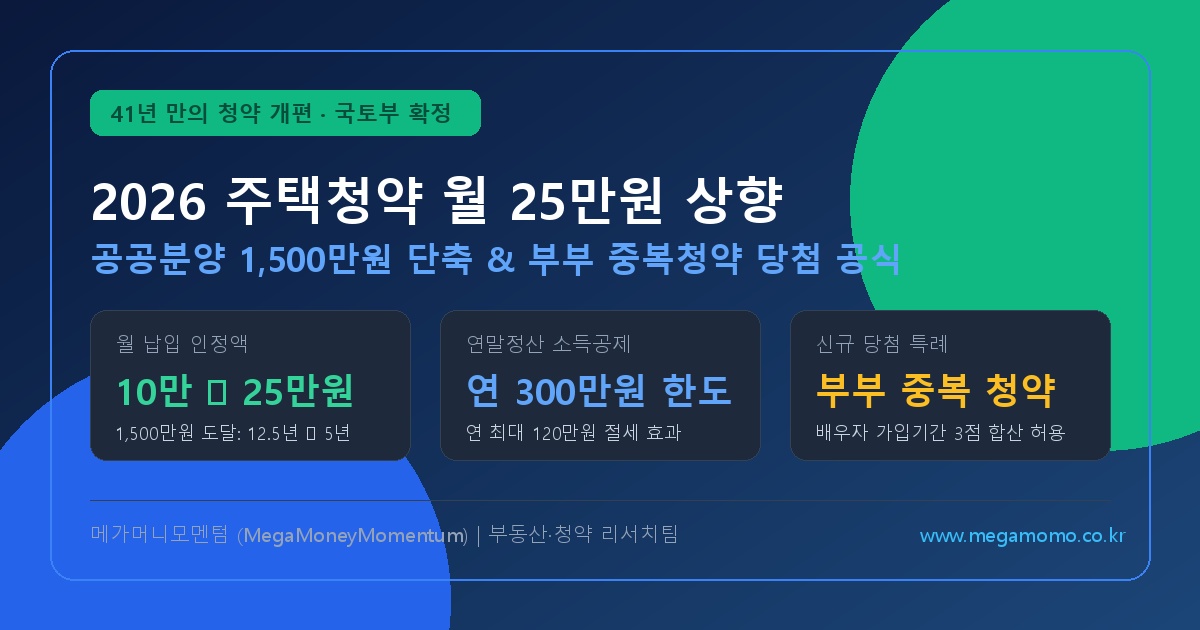
For the first time in 41 years since 1983, South Korea’s Ministry of Land, Infrastructure and Transport (MOLIT) has officially increased the monthly recognized deposit ceiling for the Comprehensive Housing Subscription Savings Account (주택청약종합저축, commonly known as ‘Cheong-yak’) from ₩100,000 to ₩250,000.
Alongside this change, major deregulation measures have taken effect: married couples can now apply for the same apartment pre-sale lottery concurrently without penalty, spouse subscription tenure can add up to 3 extra points, and the annual year-end tax settlement income deduction ceiling has expanded from ₩2.4 million to ₩3.0 million.
With more than 26 million accounts held nationwide, understanding whether to raise your monthly automated transfer to ₩250,000 depends fundamentally on your home-buying roadmap—specifically whether you target Public Housing (공공분양) or Private Commercial Housing (민간분양). Here is the definitive guide and financial simulation.
📌 4 Key Takeaways:
- Monthly Cap Raised (₩100K ➔ ₩250K): Reaching the critical ₩15 million threshold for public housing lotteries in Seoul and 3rd Generation New Towns drops dramatically from 12.5 years (150 months) to just 5.0 years (60 months).
- Year-End Tax Settlement Deduction (₩3M Ceiling): Non-homeowning household heads earning under ₩70M annually can deduct 40% of their annual deposits (up to ₩1.2M deducted from taxable income), returning ₩198,000 to ₩316,800 in cash tax refunds.
- Dual-Spouse Concurrent Applications: Husbands and wives can both submit lottery tickets for the same apartment complex. If both win, the earlier submission timestamp remains valid, doubling a household’s winning odds without cancellation risks.
- Spouse Tenure Addition (+3 Pts): In private housing point evaluations, applicants can merge 50% of their spouse’s subscription history, granting up to 3 bonus points toward the 84-point maximum.
1. Why Did the Government Raise the Cap After 41 Years?
Since the subscription system debuted in 1983, apartment construction prices and inflation have surged more than tenfold. Capping recognized monthly deposits at ₩100,000 eroded the system’s ability to differentiate serious long-term prospective buyers.
The 2026 overhaul accomplishes three policy goals:
- Reflecting Contemporary Real Estate Valuations: With metropolitan pre-sale prices averaging well above ₩30 million per 3.3㎡ (pyeong), larger recognized deposits reflect realistic purchasing power.
- Preventing Account Cancellations: By increasing statutory deposit interest rates up to 3.1% (and up to 4.5% for youth accounts) and boosting tax refund perks, the government aims to stop young earners from abandoning their accounts.
- Replenishing the National Housing and Urban Fund (NHUF): Subscription deposits finance low-interest government mortgage loans (such as Didimdol and Stepping Stone Loans).
[!IMPORTANT] Bank Transfers Do Not Auto-Update!
Commercial banks (KB, Shinhan, Woori, Hana, NH, etc.) do NOT automatically alter your existing standing orders. If you want the full ₩250,000 recognized benefit, you must manually log into your mobile banking app and change your monthly recurring transfer from ₩100,000 to ₩250,000.
2. Public vs. Private Pre-Sales: Should You Upgrade to ₩250K?
The single most critical question is: “Does upgrading to ₩250,000 benefit your specific situation?” The answer depends entirely on the pre-sale lottery category you are targeting.
3. Financial Simulation: Time Needed to Reach Winning Cutoffs
In competitive metropolitan areas like Goyang Changneung, Hanam Gyosan, Namyangju Wangsuk, and Magok/Wirye, historical winning cutoffs for public pre-sales range from ₩15M to ₩24M.
Comparing the previous ₩100,000 cap against the new ₩250,000 cap reveals a massive acceleration:
| Target Recognized Total | Old ₩100K/Month Pace | New ₩250K/Month Pace | Time Saved |
|---|---|---|---|
| ₩6,000,000 (Provincial Public Housing) | 5.0 Years (60 mos) | 2.0 Years (24 mos) | 3 Years Saved |
| ₩12,000,000 (Outer Gyeonggi Cutoff) | 10.0 Years (120 mos) | 4.0 Years (48 mos) | 6 Years Saved |
| ₩15,000,000 (3rd Gen New Town Hotspots) | 12.5 Years (150 mos) | 5.0 Years (60 mos) | 7.5 Years Saved |
| ₩21,000,000 (Seoul Perimeter Competitive) | 17.5 Years (210 mos) | 7.0 Years (84 mos) | 10.5 Years Saved |
| ₩24,000,000 (Core Seoul 1st Tier Priority) | 20.0 Years (240 mos) | 8.0 Years (96 mos) | 12 Years Saved |
[!WARNING] Existing Long-Term Savers Risk Being Surpassed:
If an existing account holder with ₩12 million (accumulated over 10 years at ₩100K) remains at ₩100K, a newcomer saving ₩250K each month will surpass them in 6 years and 8 months. Maintaining competitive priority in public pre-sales requires stepping up to ₩250K.
4. Year-End Tax Settlement: ₩3.0M Limit & Exact Cash Refund
In synchronization with the monthly cap change, Article 87 of the Restriction of Special Taxation Act increased the annual housing subscription deposit deduction cap from ₩2.4 million to ₩3.0 million.
- Eligibility: Wage earners with gross annual salary ≤ ₩70 million who are non-homeowning household heads (세대주) as of December 31.
- Deduction Rate: 40% of annual deposits (maximum ₩1.2 million deducted from taxable income).
- Perfect Alignment: ₩250,000/month × 12 months = exactly ₩3,000,000/year, maximizing the deduction to the penny.
💰 Tax Refund Calculation by Income Bracket
The ₩1.2 million income deduction lowers your taxable base. The actual refund deposited back into your bank account during the February tax settlement depends on your tax bracket:
| Gross Annual Salary | Taxable Income Bracket | Marginal Tax Rate (+ Local 10%) | Actual Cash Tax Refund |
|---|---|---|---|
| Under ₩30,000,000 | Under ₩14,000,000 | 6.6% (6.0% + 0.6%) | ₩79,200 |
| ₩35M – ₩60,000,000 | ₩14M – ₩50,000,000 | 16.5% (15.0% + 1.5%) | ₩198,000 |
| ₩60M – ₩70,000,000 | ₩50M – ₩88,000,000 | 26.4% (24.0% + 2.4%) | ₩316,800 |
For workers in the ₩50M–₩70M salary range, depositing ₩250,000 monthly produces a guaranteed ₩316,800 cash return, equivalent to an additional guaranteed 10.5% return on your capital.
5. Three Golden Deregulation Rules to Double Your Winning Chances
MOLIT has introduced three critical rule updates that make housing lottery entries far more forgiving for families:
Dual-Spouse Concurrent Applications
Both husband and wife can submit independent applications for special or general pre-sales in the exact same apartment complex. Under legacy rules, dual winning caused disqualification; under 2026 rules, the application submitted earlier on Applyhome is recognized as valid.
Spouse Subscription Tenure Merging (+3 Pts)
In private housing point calculations, applicants can merge 50% of their spouse's account tenure points (up to 3 points). If a husband has 5 years of tenure (7 pts) and the wife has 4 years (6 pts), the husband receives 7 + 3 = 10 points when applying.
Newborn Special Supply & 2-Child Multi-Child Policy
A massive 70,000 annual pre-sale quota is reserved for households pregnant or giving birth within 2 years of the announcement. Furthermore, the 'Multi-Child (다자녀)' special pre-sale eligibility has dropped from 3 children to just 2 children nationwide.
6. Upgrading Legacy Accounts (저축, 예금, 부금)
Holders of pre-2009 legacy accounts (청약저축, 청약예금, 청약부금) can now switch without sacrificing past equity:
- The New Rule: You can convert directly to the modern Comprehensive Housing Subscription Savings Account (주택청약종합저축) while retaining 100% of your accumulated deposit balance and registration tenure.
- Why Convert? Legacy savings only applied to public housing, while legacy installment deposits only applied to private units. The modern comprehensive account unlocks all property types and qualifies for the new ₩250K monthly cap.
7. Frequently Asked Questions (FAQ)
Q1. What if ₩250,000 every month is too burdensome?
Subscription accounts are not rigid debt commitments. You can deposit ₩250,000 when funds are plentiful, and scale back to ₩100,000 or ₩20,000 during tighter months. If your goal is exclusively private commercial housing, you only need the static minimum balance (₩3M for Seoul) and do not need to maintain ₩250,000 monthly.
Q2. Does depositing ₩500,000 count as 2 monthly installments?
No. Even if you deposit ₩500,000 in a single transaction, the maximum recognized amount for that billing calendar month is legally capped at ₩250,000.
Q3. Can foreign residents open and use a Cheong-yak account?
Yes. Foreigners holding an Alien Registration Card (ARC) can open a Housing Subscription Account at any Korean commercial bank. While priority in public housing pre-sales generally targets Korean citizens, registered foreign residents can actively participate in private commercial housing lotteries (추첨제 random draws) once minimum balance criteria are met.
Q4. Does the Youth Dream Housing Account (청년주택드림 청약통장) qualify?
Yes, fully. For youths aged 19–34 with annual income ≤ ₩50 million, the account delivers up to 4.5% interest, accepts the ₩250,000 monthly ceiling, and unlocks the dedicated Youth Dream Mortgage Loan at rates as low as 2.2% upon winning a pre-sale lottery.
8. Action Checklist for Today
- Audit Your Primary Goal:
- Public Housing (LH, 3rd Gen New Town) ➔ Immediately update recurring bank transfer to ₩250,000.
- Private Commercial Pre-sales (Brand apartments) ➔ Confirm required regional lump-sum balance (₩3M–₩15M).
- Lock in Year-End Tax Deduction:
- If salary is ≤ ₩70M and you are a non-homeowning household head, ensure you deposit ₩3M annually for up to ₩316K in cash tax refunds.
- Coordinate Dual-Spouse Strategy:
- Retain both spouse accounts to take advantage of dual applications and the +3 point tenure merger.