Every November in South Korea, hundreds of thousands of retirees, passive dividend investors, and households receive an unexpected notification that induces severe financial anxiety: a Notice of Loss of Dependent Status (피부양자 자격 상실 통보서) from the National Health Insurance Service (NHIS), accompanied by monthly bills ranging between ₩250,000 and ₩500,000 ($190 – $380/month).
Historically, non-working spouses, retired parents, and dividend earners enjoyed coverage under their employed adult children or spouses as dependents—paying ₩0 in monthly healthcare premiums.
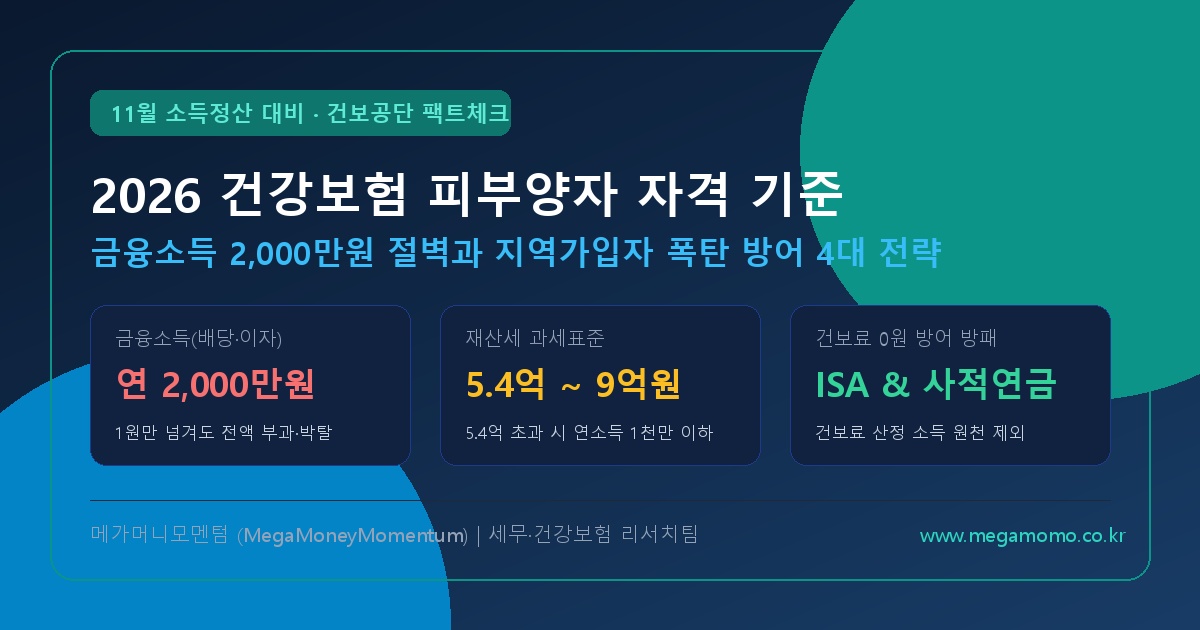
However, under tightening financial and property rules, crossing the ₩20 million ($15,000) annual financial income threshold (interest + dividends) by just ₩1 triggers an instantaneous, catastrophic transition into the Local Regional Subscriber (지역가입자) bracket, where premiums are levied not just on your income, but on the appraised value of your home and vehicle.
Here is the comprehensive breakdown of the 2026 NHIS dependent eligibility criteria, the spousal joint-disqualification mechanism, and 4 legitimate asset structuring shields to protect your household before the November reassessment.
📌 4 Essential Takeaways:
- The ₩20,000,000 “All-or-Nothing” Cliff: If total annual financial income (dividends + interest) is ₩19,999,999, healthcare assessment income is ₩0. If it hits ₩20,000,001, the entire ₩20M+ becomes subject to assessment, instantly revoking dependent status.
- Joint Spousal Disqualification: If one spouse breaches the ₩20M income threshold (or the ₩540M property limit), both husband and wife are simultaneously disqualified, converting both to regional payers.
- The Regional Conversion Penalty: Local subscribers pay premiums calculated on a point system combining income + real estate tax base + luxury vehicles, frequently generating surprise bills of ₩3M-₩6M annually for retirees.
- 4 Defense Shields: ① Move dividend assets into a Brokerage ISA (100% exempt from NHIS income reporting), ② Prioritize private pensions (IRP/Pension Savings are legally excluded from NHIS levies), ③ Harvest capital gains before year-end ex-dividend dates, ④ Apply for Voluntary Continuous Coverage within 2 months of retiring.
1. 2026 NHIS Dependent Disqualification Rules: Income & Property
To maintain dependent status under an employed family member, you must satisfy both the Income Criteria and the Property Criteria simultaneously. Failing either criterion revokes coverage immediately.
[!WARNING] Joint Spousal Disqualification Rule:
In NHIS statutory law, married couples are treated as an inseparable financial unit. If a retired husband collects ₩21 million in public pension and loses his dependent status, his wife (who has zero personal income) is automatically stripped of her dependent status at the exact same moment.
2. The ₩20M Financial Income Cliff: A Real-Life Simulation
In standard progressive taxation, earning an extra ₩100,000 only increases taxes on that marginal ₩100,000. However, in the Korean National Health Insurance system, financial income operates under an All-or-Nothing binary rule:
- Financial Income of ₩19,990,000: Evaluated as ₩0 for NHIS purposes. Zero premiums owed; dependent status preserved.
- Financial Income of ₩20,010,000: The entire ₩20,010,000 is reported. Dependent status is canceled; premiums are assessed on total income plus home equity.
💥 Simulation: Gaining ₩600K in Dividends Costs ₩3.48M in Premiums
Consider Retiree Mr. Kim, who owns a primary apartment with a government assessed base of ₩480 million (market value approx. ₩800M):
| Factor | Scenario A (₩19.9M Dividends) | Scenario B (₩20.5M Dividends) | Financial Impact |
|---|---|---|---|
| Gross Financial Income | ₩19,900,000 | ₩20,500,000 | +₩600,000 cash |
| Dependent Status | Maintained (₩0/mo) | Revoked (Regional Payer) | Disqualified |
| Income Premium Levy | ₩0 | approx. ₩120,000/month | ₩1,440,000/year |
| Property Premium Levy (Home) | ₩0 | approx. ₩170,000/month | ₩2,040,000/year |
| Annual Out-of-Pocket Cost | ₩0 | ₩3,480,000/year | -₩2.88M Net Loss! |
By chasing an additional ₩600,000 in covered-call ETF dividends, Mr. Kim unleashed his dormant apartment property points, suffering a net out-of-pocket loss of ₩2.88 million.
3. Four Shields to Neutralize NHIS Premium Hikes
To prevent the dreaded November reassessment notification, high-dividend investors and retirees should structure their assets using these 4 proven mechanisms:
Migrate High-Dividend Assets to a Brokerage ISA
The premier defense weapon in Korea. While dividends in standard brokerage accounts are transmitted directly to the NHIS database, all dividend and interest income generated inside an Individual Savings Account (ISA) is legally classified as separate, tax-free or 9.9% separately taxed, and is 100% excluded from NHIS income calculations.
Maximize Private Pension Withdrawals (IRP & Pension Savings)
While public pensions (National Pension) count toward the ₩20M disqualification ceiling, private pension withdrawals from IRPs and Pension Savings Accounts are legally exempt from healthcare premium calculations under current statutory enforcement.
Year-End Ex-Dividend Trimming & Spousal Gifting
If projected dividends threaten to cross ₩20 million in December, sell high-yielding shares prior to the ex-dividend date to lock in capital gains (domestic capital gains are exempt from NHIS premium calculations). Alternatively, take advantage of the ₩600M tax-free spousal gift allowance to distribute stock ownership equally.
Retirees: Exercise 'Voluntary Continuous Coverage' Within 60 Days
If retiring from employment causes your new regional premium (driven by your apartment or car) to exceed your former employee contribution, file for 'Voluntary Continuous Coverage (임의계속가입)' at your local NHIS branch within 2 months of receiving your first bill to freeze your premium at the lower workplace rate for up to 36 months.
4. Frequently Asked Questions (FAQ)
Q1. Do capital gains from US stocks (해외주식 양도소득세) trigger NHIS dependent disqualification?
No. Under current National Health Insurance Act provisions, capital gains (양도소득) and severance pay (퇴직소득) are categorized as temporary, non-recurring income streams and are completely excluded from health insurance premium assessments. Even if you realize ₩50 million in capital gains from US equities, it will not count toward the ₩20M ceiling. (However, any cash dividends received from US stocks do count toward the ₩20M financial income limit.)
Q2. I earned ₩100,000 from occasional 3.3% freelance work. Will I lose dependent status?
- If you have a formal Business Registration (사업자등록): Yes, generating even ₩1 of net profit will result in disqualification.
- If you are an unregistered freelancer (3.3% withholding): You retain dependent status as long as your net annual freelance income remains under ₩5,000,000.
Q3. If I am disqualified, can I re-qualify as a dependent later?
Yes, immediately. If you reduce your dividend income below ₩20M in the subsequent year or close a loss-making registered business, you can submit an application for Dependent Qualification along with proof of reduced income to your local NHIS office to reinstate dependent coverage under your family member.
5. Pre-November Action Checklist
- Calculate Year-to-Date Financial Income:
- Log into Hometax or your brokerage apps to verify total cumulative interest and dividend distributions earned since January 1.
- Cap General Account Dividends at ₩18M:
- Leave a safety margin of at least ₩1M–₩2M below the ₩20M cliff to prevent unexpected year-end special dividend distributions from triggering disqualification.
- Channel Incremental Capital to Tax-Advantaged Accounts:
- Funnel all future dividend-paying investments into Brokerage ISAs or IRP accounts where returns remain shielded from NHIS scrutiny.