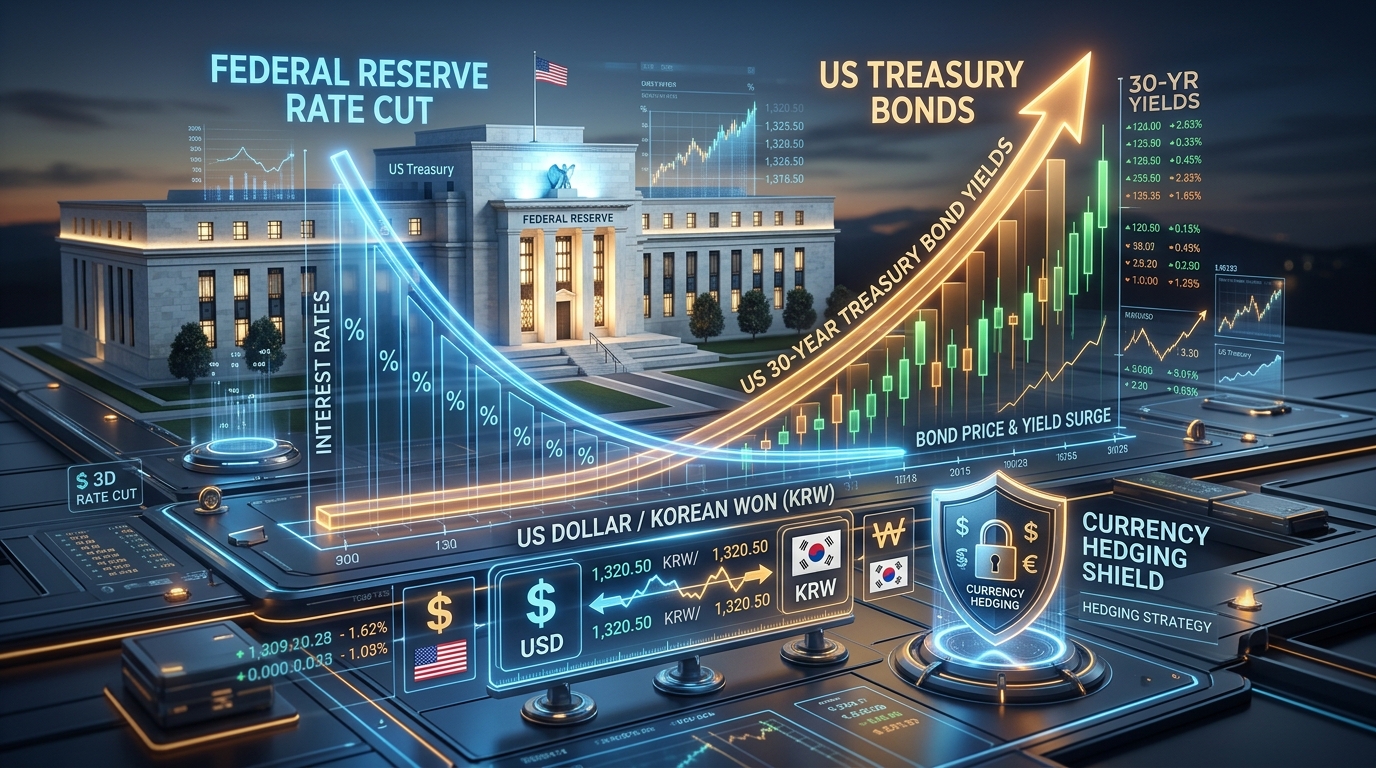
In September 2026, the moment global financial markets have anticipated for four years has officially arrived: the Federal Reserve’s monetary easing cycle (Pivot) is underway.
With US inflation stabilizing near the Fed’s 2% target and labor markets demonstrating cooling trends, Fed Chair Jerome Powell cemented the end of monetary tightening at Jackson Hole and initiated the benchmark rate cut cycle at the September FOMC meeting.
When central banks slash interest rates, the single asset class that delivers the most explosive capital appreciation (Price Return) is US Long-Term Treasury Bonds. As a result, global investors and Korean retail traders have poured trillions of won into US 30-Year Treasury ETFs (like iShares TLT and Korea-listed ACE/TIGER 30-Year Treasury series).
However, jumping in solely based on falling yields without understanding foreign exchange dynamics can be disastrous: a sharp decline in the USD/KRW exchange rate can wipe out your entire bond price gain through currency losses (환차손).
This comprehensive guide dissects the macro mechanics of the September 2026 Fed rate cut, how Duration-17 unleashes massive capital upside, and the definitive decision matrix for ‘Currency-Hedged (H) vs Unhedged’ bond investing.
📌 Key Takeaways:
- The Leverage of 17-Year Duration: US 30-year Treasury bonds possess an effective duration of approximately 17 years. A 1.0%p decline in benchmark yields translates to roughly a +17% surge in bond prices, making them the ultimate capital gains engine in an easing cycle.
- Currency Hedging (H) Dominance During Dollar Declines: When the Fed cuts rates, the dollar naturally depreciates against the Korean won (e.g., from ₩1,380 down to ₩1,250). Unhedged ETFs (like TLT) lose 7% to 10% in FX conversion, while currency-hedged ETFs (H) fully preserve the +17% bond price rally.
- Conquering the Retirement Pension (DC/IRP) 30% Rule: Domestically listed US 30-Year Treasury ETFs are legally classified as “Safe Assets” in South Korea, allowing investors to allocate up to 100% of their mandatory 30% safe-haven retirement quota into aggressive rate-cut upside with zero immediate capital gains tax.
1. The September 2026 Fed Pivot and ‘Duration-17’ Mechanics
The core axiom of fixed-income investing is straightforward: “When market interest rates drop, the prices of existing bonds with higher coupon rates rise.”
However, the magnitude of this price surge depends entirely on the bond’s maturity, measured by Duration (interest rate sensitivity).
The Mathematical Formula for Bond Price Movement
📌 Bond Price Change (%) ≈ -Duration × Yield Change (%p)
With an effective duration of roughly 16.5 to 17.5 years, if 30-year US Treasury yields retreat by 1.0%p (100 bps) from 4.4% to 3.4%, the underlying bond ETF surges by approximately +17%. This offers stock-like returns with sovereign government backing.
2. The FX Trap: Currency-Hedged (H) vs Unhedged Real Returns
For global investors and expats in Korea, bond returns are filtered through the USD/KRW exchange rate.
Typically, Fed interest rate cuts weaken the US dollar, causing USD/KRW to fall (won strengthens). What happens to your returns if you hold an unhedged ETF like TLT during an exchange rate drop?
┌────────────────────────────────────────────────────────────────────────────────────────┐
│  [ Scenario: US 30Y Yield Drops 1.0%p & USD/KRW Drops from ₩1,380 to ₩1,260 ]          │
├────────────────────────────────────────────────────────────────────────────────────────┤
│  1. 🇺🇸 Unhedged ETF (US-Listed TLT or Domestic Unhedged Series)                        │
│     • Bond Price Capital Gain: +17.0%                                                  │
│     • Currency Loss (USD/KRW -8.7%): -8.7%                                             │
│     • Net Realized Return in KRW: ~+8.3% (Over half of your bond gains evaporate!)     │
├────────────────────────────────────────────────────────────────────────────────────────┤
│  2. 🛡️ Currency-Hedged ETF (Korea-Listed ETFs with '(H)' in the ticker)                │
│     • Bond Price Capital Gain: +17.0%                                                  │
│     • Currency Risk: 0% (Protected against USD depreciation down to ₩1,200 or ₩1,100)  │
│     • Annual Hedging Cost (FX Swap Premium): ~-1.5% p.a.                               │
│     • Net Realized Return in KRW: ~+15.5% (Full preservation of rate-cut upside!)      │
└────────────────────────────────────────────────────────────────────────────────────────┘
[!IMPORTANT] The Golden Rule for Choosing (H) vs Unhedged:
- When USD/KRW is in the Elevated Range (Above ₩1,350): Rate cuts will likely drag the dollar down into the ₩1,200s. A Currency-Hedged (H) ETF is mathematically superior to prevent FX erosion.
- When USD/KRW is in the Depressed Range (Below ₩1,200): Buying Unhedged allows you to capture dollar appreciation during future crises.
- In September 2026, with USD/KRW lingering near the mid-₩1,300s, currency-hedged (H) products provide the safest exposure to the Fed easing cycle.
3. Account Strategies: Exploiting the Korean Retirement 30% Rule
Where you hold your bond ETFs dramatically alters your after-tax yield, particularly when navigating the Retirement Pension (DC/IRP) 30% Safe Asset Rule.
[!TIP] Retirement Pension (DC/IRP) Optimization Secret: Korean law dictates that Defined Contribution (DC) and Individual Retirement Pension (IRP) accounts cannot invest more than 70% in risky assets (equities). The remaining 30% must be parked in “safe assets” like bank deposits or bond funds. Instead of leaving that 30% in 2% bank deposits, allocating it to Korea-listed US 30-Year Treasury Active (H) satisfies the 30% safety rule while unlocking double-digit (+15%+) capital appreciation during rate-cut cycles!
4. 3-Step Practical Portfolio Allocation for Late 2026
Aggressive Capital Gains: Korea-Listed US 30Y Treasury (H)
Maximize duration-17 upside without currency drag. Inside an ISA or IRP, allocate capital into 'ACE US 30-Year Treasury Active (H)' or 'TIGER US 30-Year Treasury Premium Active (H)'.
Balanced All-Weather: 50% Hedged + 50% Unhedged Barbell
If you want rate-cut capital gains but also desire a dollar-hedge against global geopolitical turmoil, split your bond allocation equally between hedged (H) and unhedged products.
Monthly Income: Covered Call 30-Year Treasury ETFs
If you prioritize monthly cash flow alongside duration exposure, combine 20% to 30% in covered call bond ETFs like 'KODEX US 30-Year Treasury +12% Premium (Synthetic H)' or US-listed 'TLTW'.
5. Verify Your Portfolio Allocation with our Free Live Simulator
Want to see how adding US 30-Year Treasuries to your S&P 500 and dividend portfolio improves your risk-adjusted return and reduces portfolio drawdowns (MDD)?
Use our newly updated Global ETF Multi-Asset & Historical Backtest Simulator:
- 🎛️ Simulate customized allocations across S&P 500, Nasdaq 100, SCHD, Covered Calls, and Treasury Bonds
- ⏳ Test historical 1 to 30-year rate cycles (1996~2026) with real historical prices and dividend payouts
- 🛡️ Calculate exact after-tax savings (Alpha) across Standard vs ISA vs Pension accounts
- 🚨 Automated ₩20M Comprehensive Financial Tax alerts and health insurance tracking
👉 Launch the Free Interactive ETF Portfolio Simulator (/en/etf)
6. Frequently Asked Questions (FAQ)
Q1. Could 30-year Treasury yields fail to drop even after the Fed cuts rates?
Yes, temporarily. The Fed controls the Federal Funds Rate (ultra-short-term rate), but 30-year yields reflect long-term inflation expectations and the volume of US government debt issuance. If massive fiscal deficits flood the market with bond supply, long-term yields may lag short-term rate cuts. Dollar-cost averaging across 3 to 6 months mitigates this timing risk.
Q2. Do Korea-listed Treasury ETFs match the performance of US-listed TLT?
Yes, the underlying asset performance is identical. Products like ACE US 30-Year Treasury track physical US long-term bonds, capturing the same price movements as TLT. Furthermore, Korea-listed products offer currency-hedged options, eligibility for ISA and Retirement Pension (DC/IRP) accounts, and significant tax advantages.
Q3. What is the outlook for 3x leveraged bond ETFs like TMF?
Strongly discouraged for long-term holds. Direxion Daily 20+ Year Treasury Bull 3X (TMF) is rebalanced daily. Any volatility, chop, or yield pauses trigger severe ‘Volatility Drag’ (beta decay), eroding your principal even if yields eventually drop. Stick to 1x unleveraged ETFs for sustained multi-quarter easing cycles.
Q4. Must I hold long-term Treasury ETFs until maturity in my retirement account?
No, absolutely not. ETFs are publicly traded exchange funds. Whenever bond yields drop and you achieve your target capital gain (e.g., +15% to +25%), you can sell your shares instantly during trading hours and reallocate your capital into equity index ETFs or high-yield cash equivalents.