For residential property owners and foreign investors in South Korea, the Comprehensive Real Estate Holding Tax (종합부동산세 or ‘Jongbuse’) represents the most consequential annual property holding levy.
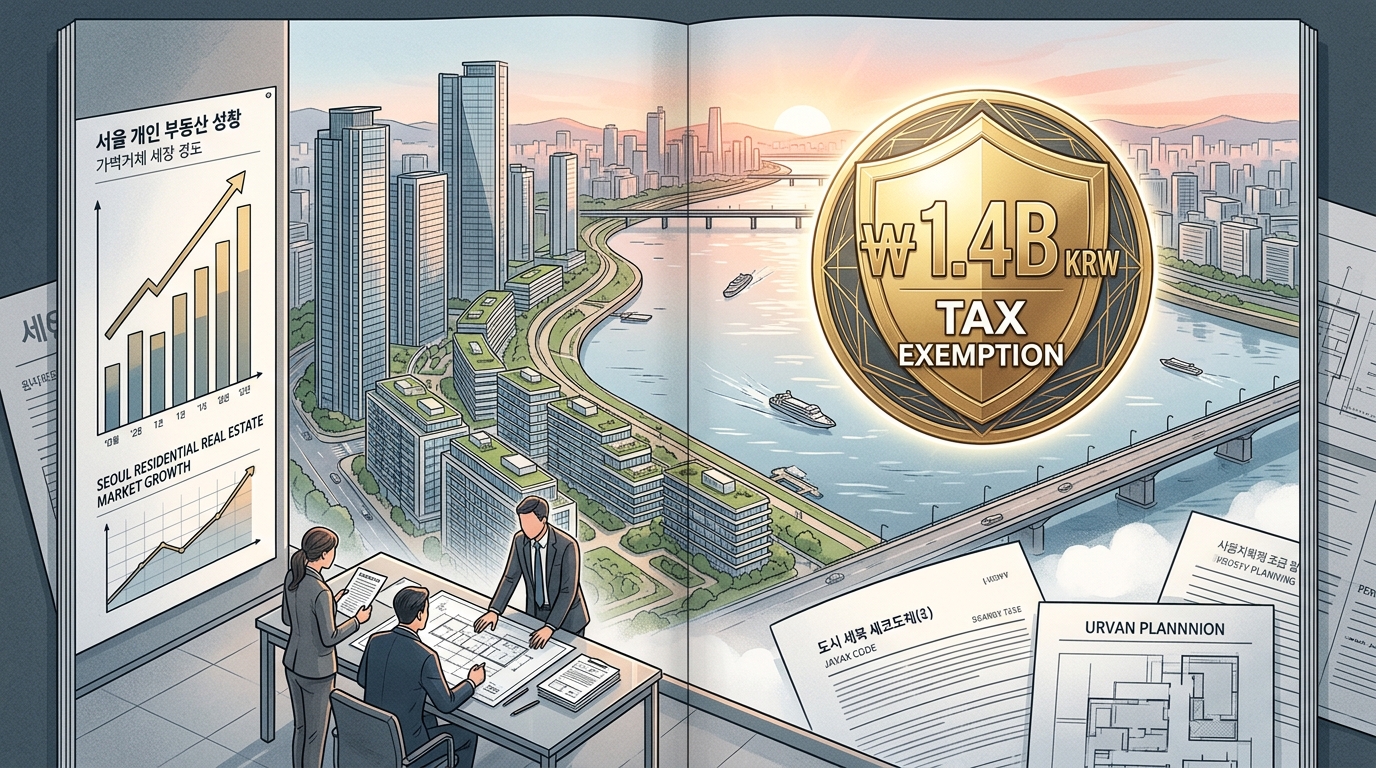
Under the 2026 Property Tax Reform, the baseline statutory tax exemption for actual-resident single homeowners has been expanded from 1.2 Billion to 1.4 Billion KRW in officially assessed value (equivalent to ~2.0 Billion KRW / $1.5M in market price), completely exempting the vast majority of middle-class primary residences.
Furthermore, punitive multi-home progressive surcharges based purely on property count have been repealed in favor of a normalized single rate schedule based strictly on total aggregate assessed value.
This master guide details the 2026 statutory framework, property value holding tax simulations, and joint-ownership tax optimization strategies.
1. 3 Major Pillars of the 2026 Property Tax Reform
2. Statutory Assessment Formula & Live Tax Simulator
Under statutory regulations, the property tax assessment multiplies net assessed equity by the 60% statutory fair market value ratio:
📌 [Statutory Holding Tax Assessment Formula]
Tax Base = (Total National Assessed Price - Base Exemption) × Fair Market Value Ratio (60%)
- Base Exemption: 1-Homeowner 1.4 Billion KRW / Joint Couple 1.8 Billion KRW / Multi-Home 900 Million KRW
- Tax Assessed = Tax Base × Statutory Tax Rate (0.5% – 2.7%) - Duplicate Local Property Tax Credit - Elderly/Long-term Deductions (Up to 80%)
Calculate Your 2026 Comprehensive Real Estate Tax Savings
Based on 2026 Ministry of Economy & Finance reform (1.4B KRW deduction & 60% valuation ratio)
3. [Verified Simulation] Annual Holding Tax Impact by Apartment Market Value
Annual holding tax for single homeowners under the prior 1.2B KRW vs. revised 1.4B KRW deduction (assuming standard ~69% government assessment ratio):
| Market Value (Est.) | Government Assessed Price | Prior Holding Tax (1.2B Deduction) | 2026 Revised Holding Tax (1.4B Deduction) | Annual Cash Saved |
|---|---|---|---|---|
| 1.5 Billion KRW | ~1.03 Billion KRW | 0 KRW | 0 KRW (Full Exemption) | - |
| 1.8 Billion KRW | ~1.24 Billion KRW | ~120,000 KRW | 0 KRW (100% Tax-Free! ⭐) | Save 120,000 KRW |
| 2.0 Billion KRW | ~1.38 Billion KRW | ~540,000 KRW | 0 KRW (100% Tax-Free! ⭐) | Save 540,000 KRW |
| 2.5 Billion KRW | ~1.72 Billion KRW | ~1,780,000 KRW | ~960,000 KRW | 💰 Save 820,000 KRW / yr |
| 3.0 Billion KRW | ~2.07 Billion KRW | ~3,420,000 KRW | ~2,280,000 KRW | 🏆 Save 1,140,000 KRW / yr! |
Under the 1.4B KRW threshold, single homeowners in major Seoul residential districts with apartments valued up to 2.0 Billion KRW owe strictly 0 KRW in comprehensive holding taxes.
4. Spousal Joint Ownership vs. Single Ownership
- Joint Ownership (50:50): Each spouse receives a separate 900 Million KRW personal exemption, providing a combined 1.8 Billion KRW total deduction (equivalent to ~2.6 Billion KRW market value) at 0 KRW tax.
- Single Ownership Election: If the property owner is aged 60+ or has held the home for > 5 years, electing single-ownership special rules in September allows applying the 1.4B KRW base deduction plus up to 80% elderly/long-term tax credits.
5. Strategic Property Holding Guidelines
Verify Public Assessed Price on realtyprice.kr Each April
Confirm whether your property's assessed value sits below the 1.4B KRW baseline to anticipate zero tax status.
Simulate Joint vs. Sole Ownership Special Filings in September
Calculate if joint 1.8B deduction or single 1.4B deduction + 80% senior credit yields lower total net tax liability.
Fulfill Actual Residency Requirements for Capital Gains Shield
Maintain actual residency in your primary home for 2+ years to secure up to 80% Long-Term Holding Special Deductions upon future sale.
6. Frequently Asked Questions (FAQ)
Q1. Can foreign residents claim the 1.4 Billion KRW single homeowner deduction?
Yes. Foreign nationals holding an Alien Registration Card (ARC) who qualify as domestic tax residents and own a single residential home in South Korea for primary residence are fully entitled to the 1.4 Billion KRW base deduction.
Q2. Are inherited properties counted toward total property counts?
Inherited residential properties are excluded from property count determinations for up to 5 years, preserving your single-homeowner 1.4B KRW base deduction and senior tax credits.
Q3. When is the Comprehensive Real Estate Holding Tax billed and due?
Tax notices are dispatched by the National Tax Service in late November, with payment due annually between December 1st and December 15th.